
On this page (5)Hide
In a 2022 laboratory test, one older aging clock gave results up to 8.6 years apart when the same blood sample was measured twice [4]. Rebuilt clocks do far better, yet a fresh blood sample also brings in short-term changes in your own body [1, 4]. So when a test is called "validated" and your score has just changed, it pays to ask: validated for what?
The tests discussed here use aging clocks. These formulas turn chemical tags on blood-cell DNA, called DNA methylation, into an estimate such as a biological age or a pace of aging [2]. Researchers describe several kinds of validation, from showing that a measurement is reliable to showing that it helps people stay healthy [3].
For someone holding a result, they come down to four questions. Does it repeat? Does it predict health? Does it respond to a treatment? Does a lower score predict better health?


A test can be repeated in two ways. Rerunning the same blood sample checks the laboratory. A new sample taken hours or days later also picks up short-term changes in the body, such as those around a meal or stress [1].
In the same 2022 test, a rebuilt version, PCPhenoAge, kept reruns within 1.6 years; such rebuilt clocks carry "PC" in their names [4].
A 2026 reanalysis compared both kinds of repeat for 18 clocks [1]. It reported combined, age-adjusted agreement estimates on a scale from 0 to 1, where 1 means the repeats match exactly [1]. Most clocks' combined estimates for reruns of one sample were above 0.9 [1]. For fresh samples they were mostly about 0.4 to 0.7, and none of these combined estimates reached 0.9 [1].
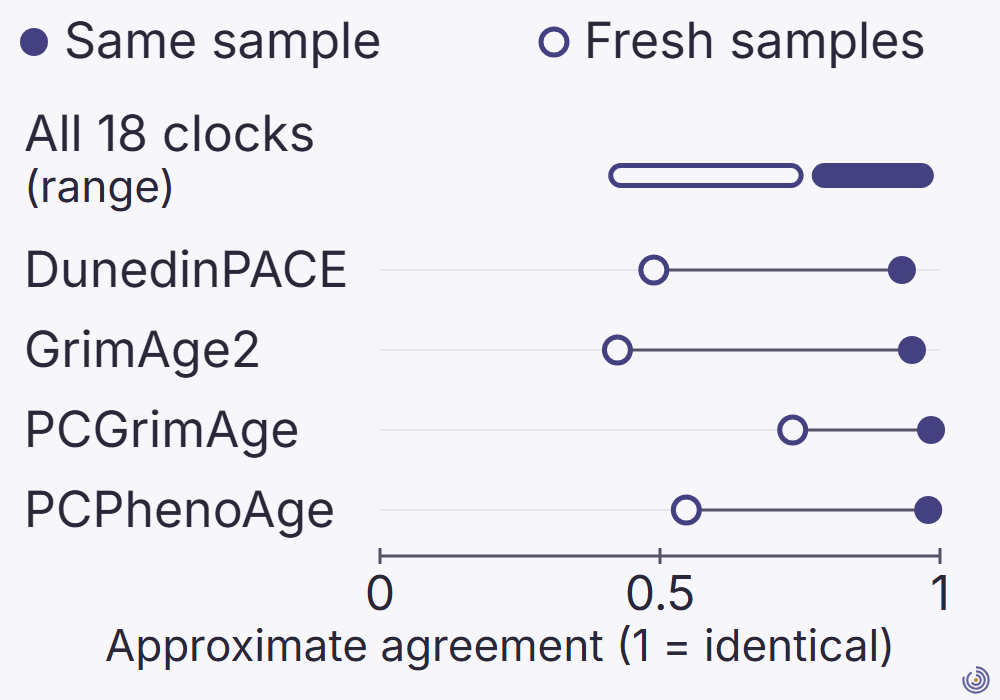
These are group-level figures from different small groups, not how far one person's result moves. The fresh samples came mostly from young adults sampled around a meal, stress, air pollution or high altitude [1]. No one was sampled at the same times without those events, so the cause of the drift is unknown [1]. Some combined values are higher than any of their parts, which the paper's stated method cannot produce, so treat these figures as approximate.
Equipment matters too: in a small study of 16 people, the same samples gave different average scores for several clocks on a newer laboratory chip [5].
DunedinPACE was built to estimate, from one blood sample, how fast 19 measures of organs and body systems changed over 20 years [2]. In a separate group of 771 older men, those with a faster DunedinPACE were more likely to develop a chronic disease or die during follow-up [2].
In a large study of older Americans, a GrimAge-based score added some information about later illness and death [6]. For most outcomes, cheaper facts such as people's background and health habits predicted more [6]. A higher score marks a higher-risk group on average, not your own exact risk, and is a link, not proof of cause.
Testing that needs a comparison group: similar people, assigned at random, who do not get the treatment [7]. Three trials have done this with aging clocks.
In CALERIE, healthy adults without obesity, around 38 years old, were asked to eat fewer calories for two years. Compared with people on their usual diet, their DunedinPACE slowed by about 2 to 3% on average, while PCPhenoAge and PCGrimAge showed no clear difference [7].
In COSMOS, 958 adults around 70 took a daily multivitamin or a dummy pill for two years [8]. Its clock study included only people who stayed free of heart attack, stroke and invasive cancer [8]. With the multivitamin, PCPhenoAge and PCGrimAge rose about a tenth to a fifth of a year less per year [8]. DunedinPACE showed no clear difference [8].
In DO-HEALTH, generally healthy Swiss adults aged 70 and over took omega-3, vitamin D, a home exercise programme or combinations for three years. Omega-3 slightly slowed PCPhenoAge, GrimAge2 and DunedinPACE; vitamin D and exercise alone showed no clear effect on the clocks [9].
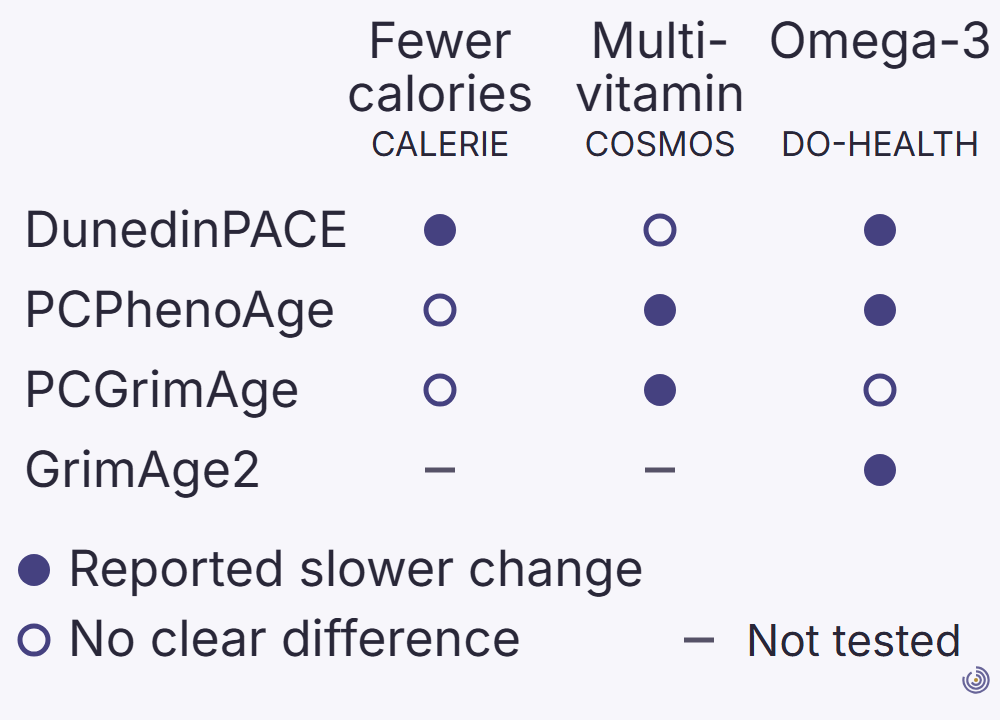
These are early signals rather than settled effects. Each trial tested several clocks, which raises the chance of a lucky result [8]. The CALERIE and DO-HEALTH clock analyses were also added after the trials were designed [7, 9]. And the trials differed in people, treatments and length, so they cannot rank treatments or clocks [8].
Averages hide a wide spread. The spread of changes in the two CALERIE groups overlapped by close to 90%, by the authors' estimate [7]. Some people who ate less even saw their DunedinPACE rise [7].
A trial finds a small average shift by comparing hundreds of people with and without the treatment; your own before-and-after pair has no such comparison.
That is the step still being tested. In these trials, a favourable result meant a score lower than the comparison group's on average, which can simply mean a slower rise [8]. CALERIE stopped following people when the diet ended, so it could not show whether the slower pace meant less disease [7]. The DO-HEALTH authors called the meaning of their clock changes for long-term survival unknown [9]. None of this denies other benefits of the treatments.
Medicine calls a measurement that stands in for how people feel, function or survive a surrogate endpoint [10]. Before a marker can play that role, strong evidence must show that changes in it predict a real health benefit [10]. Whether using a test to choose your care helps is a separate question again. A 2024 review said answering it needs prospective trials showing that people feel, function and survive better [3].
Disclosures: several authors of the cited papers hold patents, licences or consulting roles linked to aging clocks, including DunedinPACE, the PC clocks and Systems Age [1, 2, 3, 4, 5, 7, 9]. COSMOS received study pills from the supplement makers and in-kind support for its methylation measurements from FOXO Technologies [8].- Sehgal R, Borrus DS, Gonzalez J, Markov Y, Higgins-Chen A, et al. Biological versus technical reliability of epigenetic clocks and implications for disease prognosis and intervention response. Aging Cell, 2026.
- Belsky DW, Caspi A, Corcoran DL, et al. DunedinPACE, a DNA methylation biomarker of the pace of aging. eLife, 2022.
- Moqri M, Herzog C, Poganik JR, et al. Validation of biomarkers of aging. Nature Medicine, 2024.
- Higgins-Chen AT, Thrush KL, Wang Y, et al. A computational solution for bolstering reliability of epigenetic clocks: implications for clinical trials and longitudinal tracking. Nature Aging, 2022.
- Tay JH, Chew YE, Wang W, et al. DNAm age differences between Infinium MethylationEPICv1 vs EPICv2 in buffy coat, PBMC, and saliva samples. Communications Biology, 2025.
- Faul JD, Kim JK, Levine ME, et al. Epigenetic-based age acceleration in a representative sample of older Americans: associations with aging-related morbidity and mortality. PNAS, 2023.
- Waziry R, Ryan CP, Corcoran DL, et al. Effect of long-term caloric restriction on DNA methylation measures of biological aging in healthy adults from the CALERIE trial. Nature Aging, 2023.
- Li S, Hamaya R, Zhu H, et al. Effects of daily multivitamin-multimineral and cocoa extract supplementation on epigenetic aging clocks in the COSMOS randomized clinical trial. Nature Medicine, 2026.
- Bischoff-Ferrari HA, Gängler S, Wieczorek M, et al. Individual and additive effects of vitamin D, omega-3 and exercise on DNA methylation clocks of biological aging in older adults from the DO-HEALTH trial. Nature Aging, 2025.
- U.S. Food and Drug Administration. Surrogate Endpoint Resources for Drug and Biologic Development.