Contents
Epigenetic clocks are the most studied category of biological age tests. They work by reading chemical marks on your DNA — marks that change in predictable patterns as you get older. But the path from a blood sample to a biological age number involves more steps, and more assumptions, than most providers explain.
What is DNA methylation?
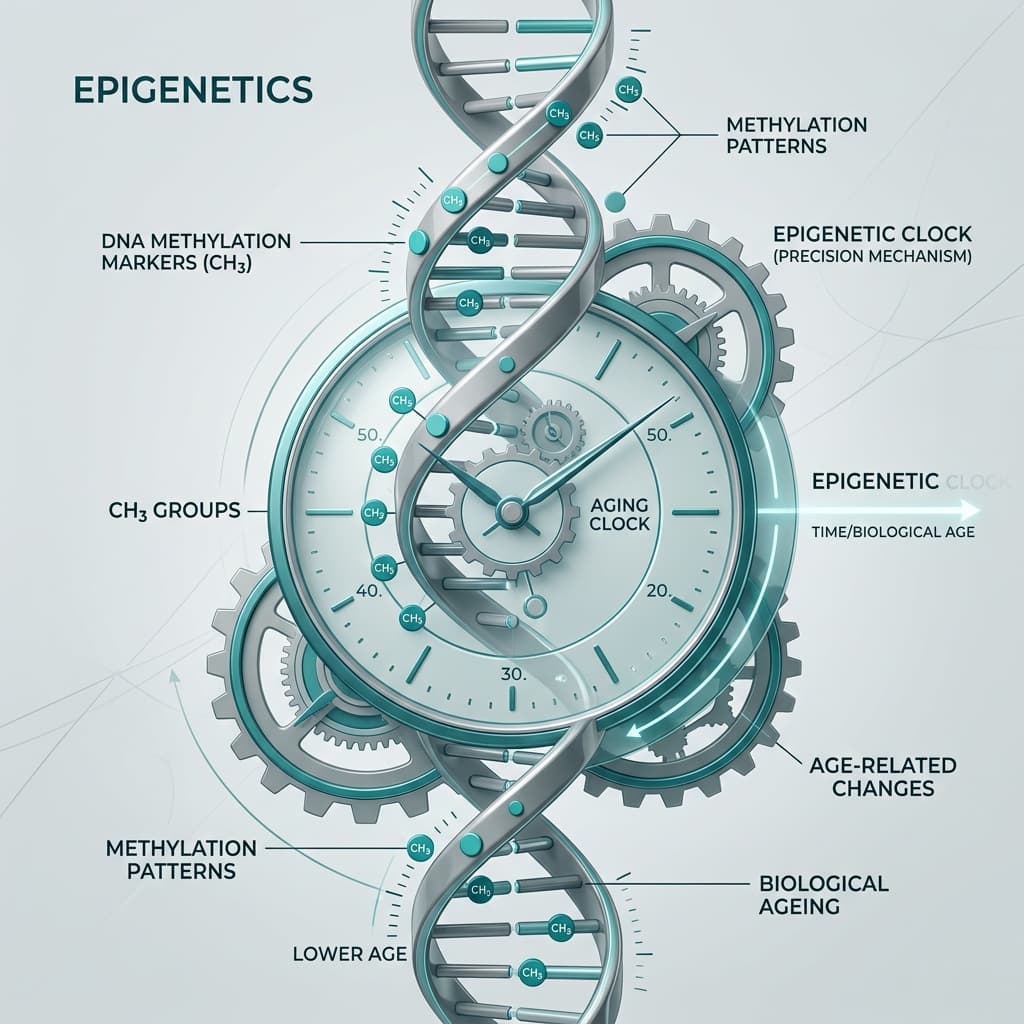
Your DNA carries chemical tags called methyl groups. These tags don't change your genetic code — they influence which genes are active or silent in a given cell. This layer of control above the genome is called the epigenome.
What makes methylation useful for aging research: the pattern of methyl tags across your genome shifts over time. Some sites gain methylation with age, others lose it. These changes are consistent enough across people that researchers can use them as a molecular clock.
How a clock is built
Building an epigenetic clock is fundamentally a statistical exercise. Researchers collect DNA samples from large groups of people whose chronological ages are known, measure methylation at hundreds of thousands of genomic sites, then use machine learning to find the combination of sites that best predicts age.
The resulting formula uses a selected subset of the sites an array can read. In the original multi-tissue clock, a penalized regression model picked the sites and fitted all their weights together; the weighted combination is then converted to years with a calibration function. Later clocks use other sets of sites, and some use nonlinear models such as the neural network in DeepMAge. Either way, the result is a predicted age.
In these development studies, accuracy was checked on datasets held back from building the model, and both clocks were less accurate there than in development. The headline figure in both papers is a median error across the test group: it describes those participants, not how close the clock will be for you. The neural-network clock was also less accurate in people with health conditions.
Why different clocks disagree
Not all epigenetic clocks answer the same question. This is the single most important thing to understand about them, and the most common source of confusion.
A third category — pace-of-aging clocks like DunedinPACE — takes a different approach entirely. Instead of estimating your cumulative biological age, these measure how fast you are currently aging, expressed as years of biological aging per calendar year.
This is why the same person can be “5 years younger” on one clock and “3 years older” on another. The clocks are answering different questions using different subsets of the methylation landscape.
What the measurement involves
In practice, a consumer epigenetic test typically works like this: you provide a blood or saliva sample, the lab extracts your DNA, treats it with a chemical (bisulfite) that reveals which sites are methylated, and runs it on a microarray chip that reads methylation levels at hundreds of thousands of positions.
The raw data is then processed through the clock's algorithm to produce your biological age estimate. The entire pipeline — from sample quality to array performance to algorithmic interpretation — introduces potential sources of variation.
What methylation changes don't tell us
The bottom line
Epigenetic clocks measure real, reproducible biological signals. The core finding — that methylation patterns shift predictably with age — is among the most replicated results in aging research. But translating a methylation pattern into a meaningful individual health metric involves layers of statistical modeling, each introducing assumptions and uncertainty.
Understanding what these clocks measure, and what they don't, is essential before comparing specific tests or interpreting your own results. The methylation signal is real. The question is what it means for you.
Sources for this update
- Horvath (2013). DNA methylation age of human tissues and cell types. Genome Biology. The author is a named inventor on a university patent application. A 2015 erratum corrected the cancer-tissue results; it states that the non-cancer tissue results remain valid.
- Galkin et al. (2021). DeepMAge: A Methylation Aging Clock Developed with Deep Learning. Aging and Disease. Written by developers at for-profit AI companies; a patent has been applied for.
- Sluiskes et al. (2024). Clarifying the biological and statistical assumptions of cross-sectional biological age predictors. BMC Medical Research Methodology. Statistical methods paper; its real-data example uses blood metabolites, not DNA methylation.