Contents
Epigenetic clocks measure DNA methylation patterns. Glycomic clocks measure sugar chains on immunoglobulins. Proteomic clocks measure hundreds of circulating proteins simultaneously. These methods can all capture meaningful biological aging signal, but they share a practical constraint: they require specialized laboratory infrastructure and purpose-built sample collection.
A study published in Nature Medicine in 2025 asks a different question. Your doctor already orders blood tests — complete blood counts, kidney panels, liver enzymes, albumin. Could a biological aging clock be built from data that exists in ordinary clinical records?
The answer, based on a large retrospective analysis of nearly ten million patients, is that something meaningful is there. What remains to be established is whether it survives the rigors of prospective validation.
What LifeClock is
The study describes EHRFormer, a transformer-based AI model trained on 24.6 million longitudinal clinical visits from 9.68 million patients in the China Health Aging Investigation (CHAI), drawn from several Chinese hospital systems. The model processes sequences of routine laboratory values across a patient's medical history and learns to extract a biological age estimate from the pattern. The researchers call the resulting output LifeClock.
The scale is unusual. Most clock development studies work with tens of thousands of participants. This one trained on a dataset an order of magnitude larger — and crucially, it did so using only the kind of data already generated by routine clinical care, not any specialized assay.
Two clocks, not one
One of the study's more notable findings emerged from the model unsupervised: it naturally identified two distinct aging trajectories, not one. The pediatric clock (covering birth through age 18) and the adult clock operate on different biological logic, with different laboratory markers carrying the signal.
The adult LifeClock emphasizes three markers most heavily. Red cell distribution width (RDW) — a measure of how variable red blood cell sizes are within a sample — tends to rise with age and is associated with inflammation and chronic disease. Blood urea nitrogen reflects kidney function and protein metabolism, both of which change with aging. Albumin, a key protein produced by the liver, declines with age and poor nutritional status.
None of these are exotic. Albumin and blood urea nitrogen appear on a standard metabolic panel; RDW comes from the complete blood count. Both are routine tests many adults have ordered annually.
The pediatric clock weighted different markers — total protein, aspartate aminotransferase (AST), and creatinine — reflecting the distinct physiology of growth and development. Most biological age research focuses on adults. The LifeClock study is one of the few to examine what aging signal looks like before adulthood.
What the model predicted
When fine-tuned for specific disease outcomes, EHRFormer achieved strong performance in retrospective analysis. Its highest figures describe current diagnosis — identifying disease a patient already has. On that task the model returned AUCs — a standard measure of discrimination — of up to 0.98 for coronary artery disease, 0.95 for atrial fibrillation, 0.97 for ischemic stroke, 0.94 for Parkinson's disease, and 0.98 for type 2 diabetes.
Forecasting is reported separately, and scores lower. For predicting disease a patient does not yet have, the paper reports AUCs ranging from 0.80 to 0.90 at five years and 0.81 to 0.91 at ten years. That gap matters: the headline figures are not the forecasting figures. High-risk clusters in adults were associated with future renal failure, cardiovascular disease, and stroke, often years before clinical diagnosis.
How this differs from epigenetic clocks
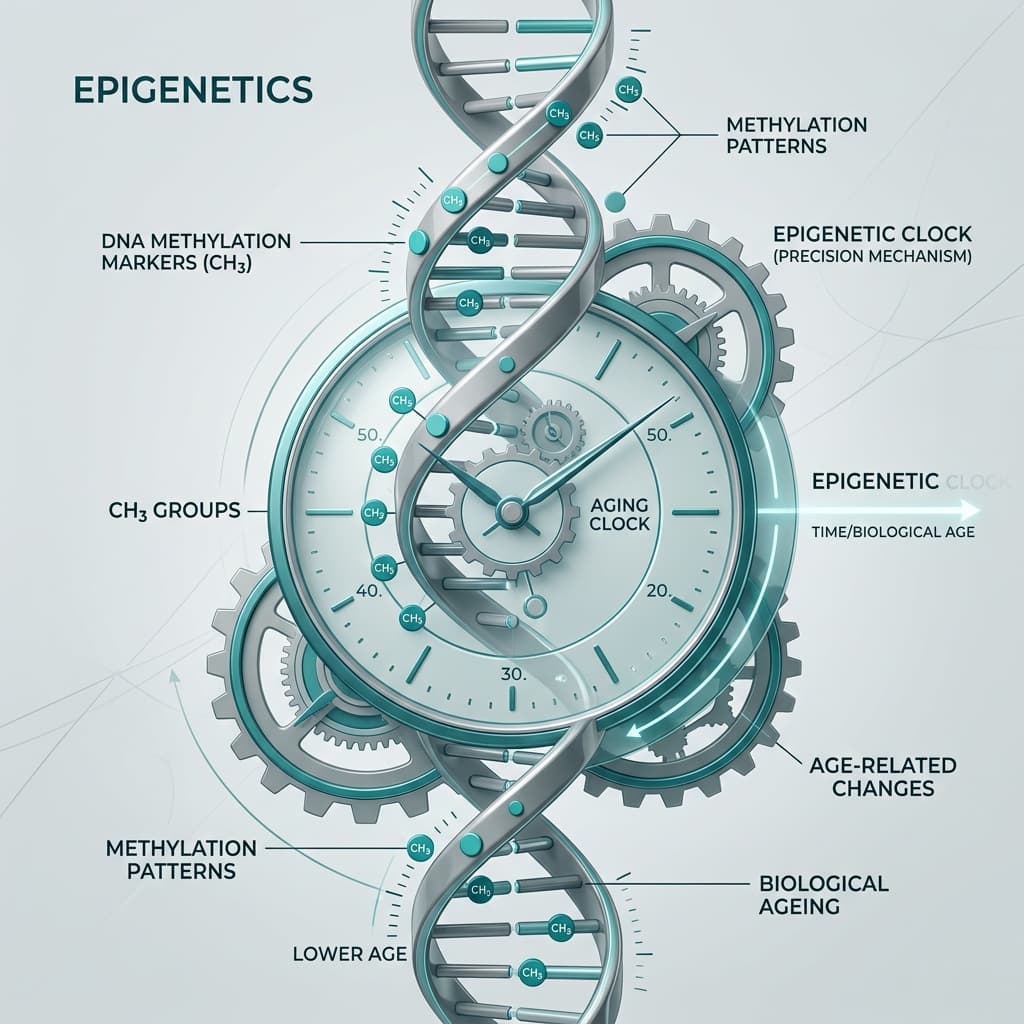
Epigenetic clocks measure DNA methylation — molecular marks on your genome that accumulate with biological age and with exposures like smoking, obesity, and chronic stress. This measures molecular marks directly, rather than their downstream physiological effects — though the resulting age estimate is still a model output, not a direct measurement of how aged a cell is.
LifeClock reads something different: the functional consequences of aging as they appear in routine clinical chemistry. RDW rising, albumin declining, kidney markers shifting — these are downstream effects of aging processes, not the molecular events that drive them.
That distinction matters for interpretation. But it also shapes the practical comparison between the two approaches. Epigenetic clocks require a specialist blood draw, methylation sequencing, and laboratory processing that costs hundreds of pounds or dollars per sample. An EHR-derived clock, if validated, could be applied to data that already exists — without ordering anything new.
The limitation running in the other direction is that routine lab values are noisy. They fluctuate with hydration, medications, acute illness, and the time of day blood was drawn. Separating a true aging signal from that variability is technically demanding. The model was externally validated on an independent hospital cohort and on UK Biobank records, with performance the authors describe as comparable. Whether that translates into prospective clinical usefulness, in other health systems with different coding practices, is still unestablished.
What this does not yet mean
LifeClock is not available as a consumer product. There is no test to order. This is a research study, not a clinical tool.
The markers it relies on — RDW, albumin, blood urea nitrogen — are already in most standard blood panels, and there is nothing wrong with tracking them over time with your doctor. But treating them as a personal biological age monitor on the basis of this paper would be premature. The model is a trained AI system that integrates these markers across longitudinal records in a specific way; looking at individual marker values in isolation is a different exercise.
What the study contributes is a proof of concept: routine clinical data contains aging signal, and a sufficiently large and well-trained model can extract it. Whether that signal holds in independent cohorts, other health systems, and prospective clinical settings is the question the research community will need to answer next.