Contents
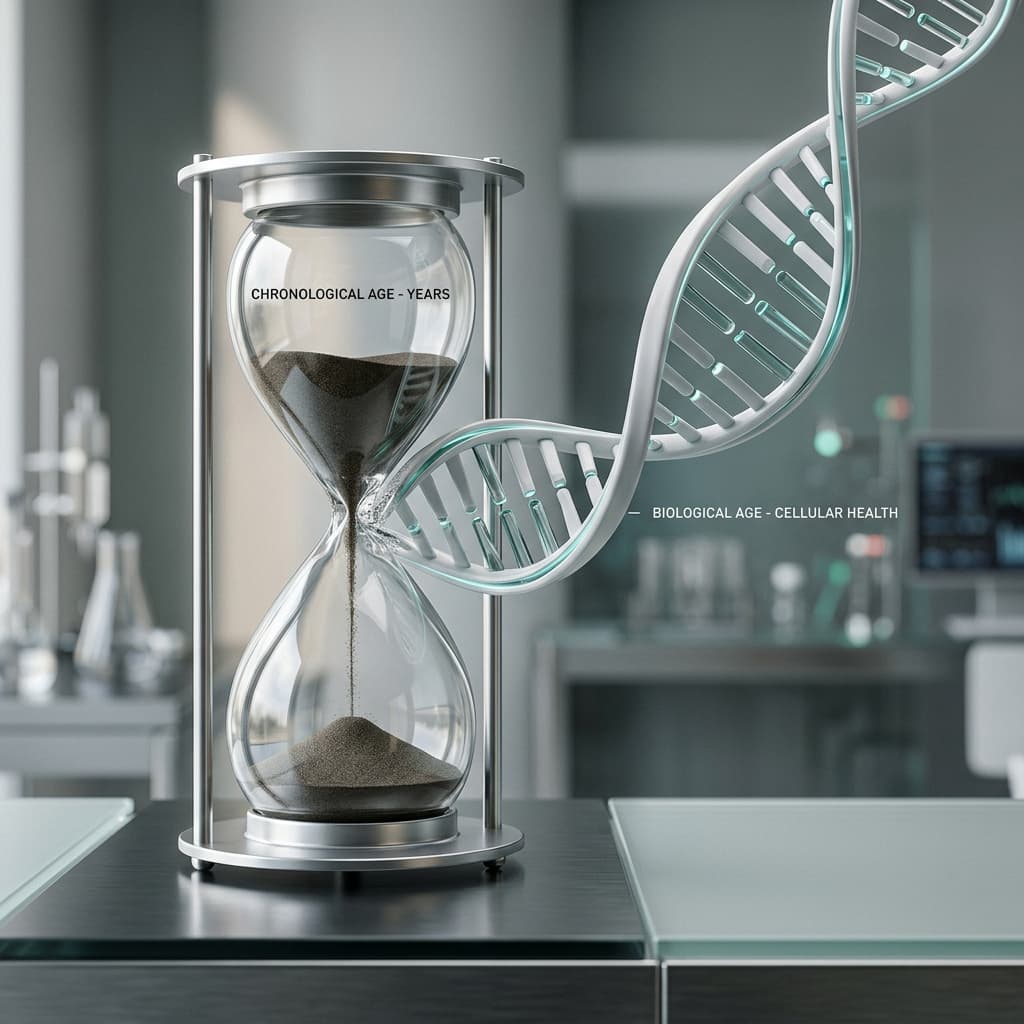
Biological age is an estimate of how old your body appears based on molecular, cellular, or physiological markers. It's different from chronological age — the number of years since you were born.
Two people born the same year can have very different biological ages. One may have cells that look younger than expected; the other, older. The idea is simple: your body doesn't always age at the same pace as the calendar.
Biological age is not a diagnosis. It's a statistical estimate produced by a model, and it should be understood as one.
How is it measured?
Biological age is calculated by feeding biological data — DNA methylation patterns, blood proteins, clinical biomarkers, or other signals — into a statistical model trained on large populations. The model outputs a number: your estimated biological age.
Different models use different inputs and are trained to predict different things. This matters, because it means there is no single “biological age.” A person can receive different biological ages from different tests, and both can be scientifically valid — they're simply measuring different dimensions of aging.
The major categories of aging clocks include epigenetic clocks (DNA methylation), proteomic clocks (blood proteins), phenotypic clocks (clinical biomarkers), and glycomic clocks (sugar molecule patterns on antibodies). Each captures something real, but none captures everything.
Two paradigms
Most aging clocks fall into one of two camps, designed to answer markedly different questions about your biology.
Neither type is “better” in absolute terms. The context determines which one is more useful.
What it can tell you
At a population level, biological age clocks are genuinely useful. They can identify groups that age faster or slower, and they predict mortality and disease risk better than chronological age alone. Researchers use them to study the biology of aging and to evaluate whether interventions might slow the process.
What it can't tell you
It is critical to approach biological age scores with the right context. A single number inevitably strips away layers of complexity.
The bottom line
Biological age is a meaningful concept backed by real science. It captures something chronological age misses: the actual state of your biology. But the gap between the science and the consumer experience is still wide. Different tests measure different things, uncertainty is underreported, and a single number inevitably simplifies a complex process.
Understanding what biological age is — and what it isn't — is the first step toward making sense of the growing market of tests and claims built around it.