Contents
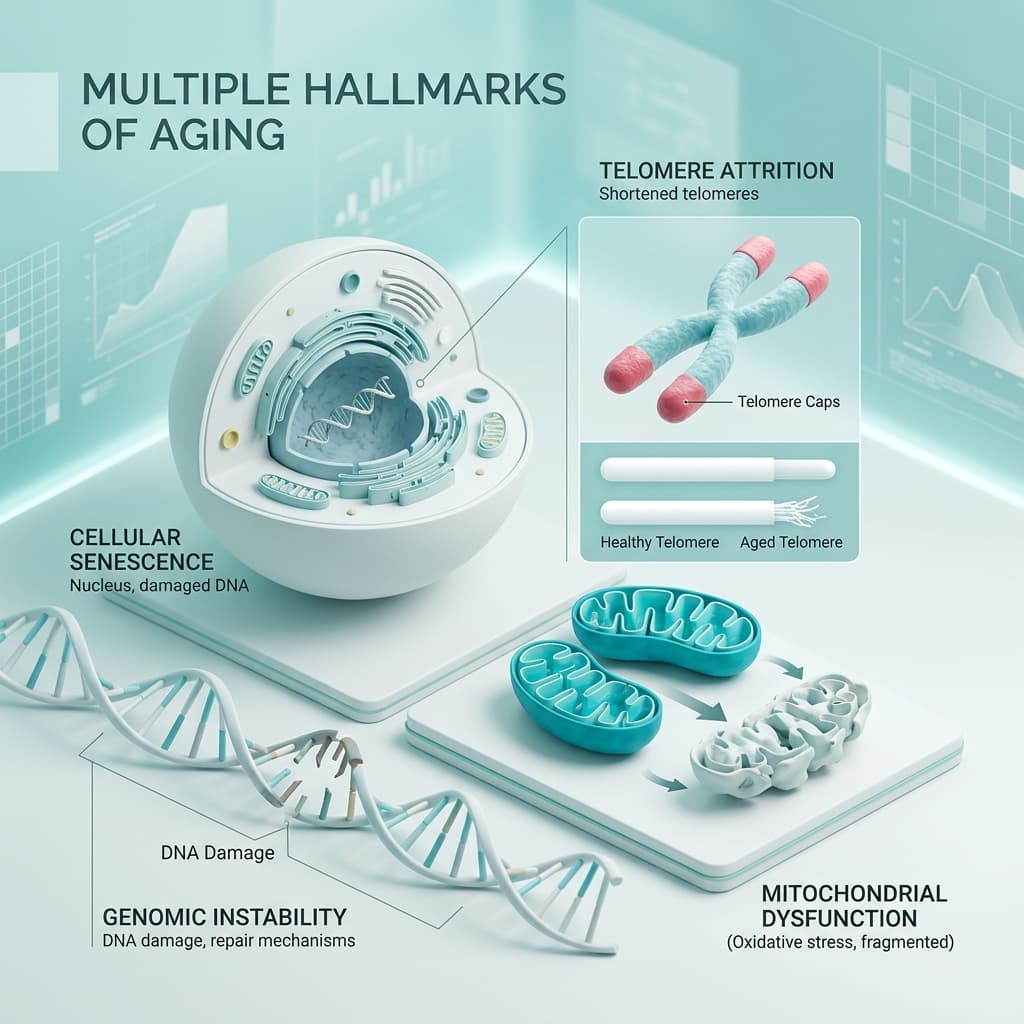
Aging isn't a single thing that happens to you. It's a collection of biological processes — DNA damage accumulating, cells losing their ability to divide, proteins misfolding, inflammation creeping upward — all unfolding at different rates in different tissues.
In 2013, researchers Carlos López-Otín and colleagues proposed a framework to organize this complexity: the Hallmarks of Aging. Updated in 2023, the framework now identifies 12 fundamental processes that drive aging across species. It's become the standard reference point for aging biology.
The four tiers
The hallmarks are organized into tiers based on their role in the aging process. Primary hallmarks are the upstream causes. Antagonistic hallmarks are responses that help at first but become harmful over time. Integrative hallmarks are the system-wide consequences. And the most recent additions capture emerging systemic effects.
Primary hallmarks
These are the root causes — the initial forms of cellular damage that set the aging process in motion.
- Genomic instability — accumulated damage to your DNA from radiation, oxidative stress, and errors in replication.
- Telomere attrition — the protective caps on chromosomes shorten with each cell division, eventually limiting a cell's ability to replicate.
- Epigenetic alterations — changes in the chemical marks that control which genes are active, disrupting normal cell function over time.
- Loss of proteostasis — the machinery that folds and recycles proteins becomes less effective, allowing damaged proteins to accumulate.
Antagonistic hallmarks
These processes are protective when they operate at low levels but become harmful when they persist or escalate.
- Disabled macroautophagy — the cell's recycling system slows down, leaving damaged components to accumulate.
- Deregulated nutrient sensing — pathways that detect food availability lose calibration, affecting metabolism and growth signals.
- Mitochondrial dysfunction — the cell's energy-producing organelles become less efficient and generate more damaging byproducts. Mitochondria are not only power plants: they also coordinate signalling, stress responses, and quality-control processes, and influence inflammation and cellular senescence. Dysfunction here means more than reduced energy output.
- Cellular senescence — damaged cells stop dividing but don't die, instead secreting inflammatory signals that affect surrounding tissue.
Integrative hallmarks
When the upstream damage isn't repaired, these system-wide consequences emerge.
- Stem cell exhaustion — the body's reservoir of regenerative cells depletes, reducing the capacity to repair tissues.
- Altered intercellular communication — cells lose their ability to coordinate effectively, disrupting tissue function.
- Chronic inflammation — low-grade, persistent inflammation (sometimes called “inflammaging”) damages tissues throughout the body.
- Dysbiosis — changes in the gut microbiome composition that affect immune function, metabolism, and inflammation.
Why this matters for biological age testing
Every biological age test measures something — but the hallmarks framework helps you understand exactly what. No single test captures all 12 hallmarks. Each approach reads a different chapter of the aging story.
Epigenetic clocks primarily measure epigenetic alterations through DNA methylation patterns. They're precise at what they do, but they're reading one hallmark in depth.
Telomere tests focus on telomere attrition — one primary hallmark out of twelve.
Comprehensive blood panels might capture inflammatory markers (chronic inflammation), metabolic indicators (deregulated nutrient sensing), and cellular damage markers (genomic instability). They cast a wider net but often trade depth for breadth.
The measurement gap
Some hallmarks are straightforward to measure. Telomere length requires a standard lab assay. Epigenetic patterns are increasingly accessible through commercial tests. Inflammatory markers show up in routine blood work.
Others are much harder. Loss of proteostasis, stem cell exhaustion, and altered intercellular communication require complex or indirect approaches that aren't yet available in consumer testing. This is why the most comprehensive commercial panels still only assess a subset of hallmarks.
Mitochondrial function illustrates the gap. Research measures exist but are specialised, and no simple standardised consumer assay establishes whole-body mitochondrial health. A test that claims to report your “mitochondrial age” is measuring a proxy, not a settled quantity.
This gap matters when you see a test claim to measure “biological age.” That number reflects whichever hallmarks the test can access — not a complete picture of your aging biology. Still valuable, but worth understanding in context.
Practical takeaways
When evaluating a biological age test, the hallmarks framework gives you a useful set of questions: Which hallmarks does this test actually measure? How directly? And what aspects of aging does it leave out?
Different tests aren't necessarily better or worse — they offer different lenses on your aging biology. An epigenetic clock and an inflammatory panel measure genuinely different things. Understanding that distinction helps you interpret results and decide which tests are relevant to your goals.
The framework also explains why biological age testing is still evolving. As researchers develop better ways to measure each hallmark, and understand how they interact, the picture will become more complete. For now, knowing what a test can and can't see is the most useful thing you can take away.