
On this page (4)Hide
“Plastic in the body” sounds like a single problem. But a tiny fragment of plastic and a chemical used to make it are different things. Once you separate them, the research on plastics and ageing becomes much easier to follow.
A plastic object is built from polymers, which form the material's basic structure. Its manufacture can also involve chemicals that give it useful properties or help form that structure. Phthalates, for example, can make some plastics flexible; BPA is used in making polycarbonate plastic and some resins [1].
Small pieces of the material are what researchers call microplastics and nanoplastics. These can be fragments or fibres, with different shapes and compositions. They are not the same thing as individual chemicals such as BPA or phthalates. Particles can carry chemicals too, so these are related parts of the exposure story, rather than two sealed categories [1, 2].
That distinction changes the question a scientist asks. Counting particles asks about pieces of material. Measuring BPA or the breakdown products of phthalates in urine asks about particular chemicals the person has encountered. It does not count plastic particles. And phthalates also occur in products such as perfumes and lotions, so the chemical measurement alone does not identify a plastic source [3, 4].
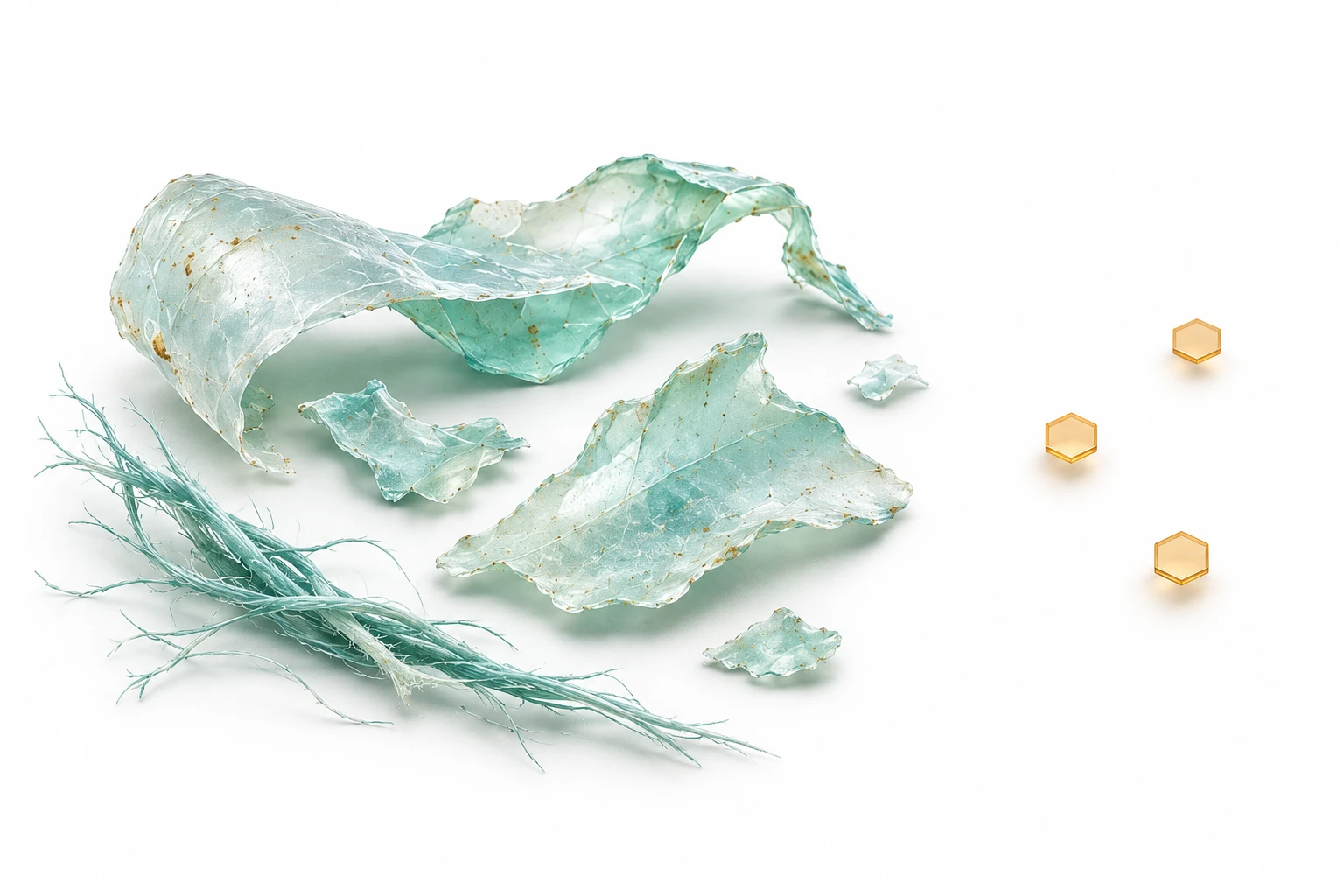

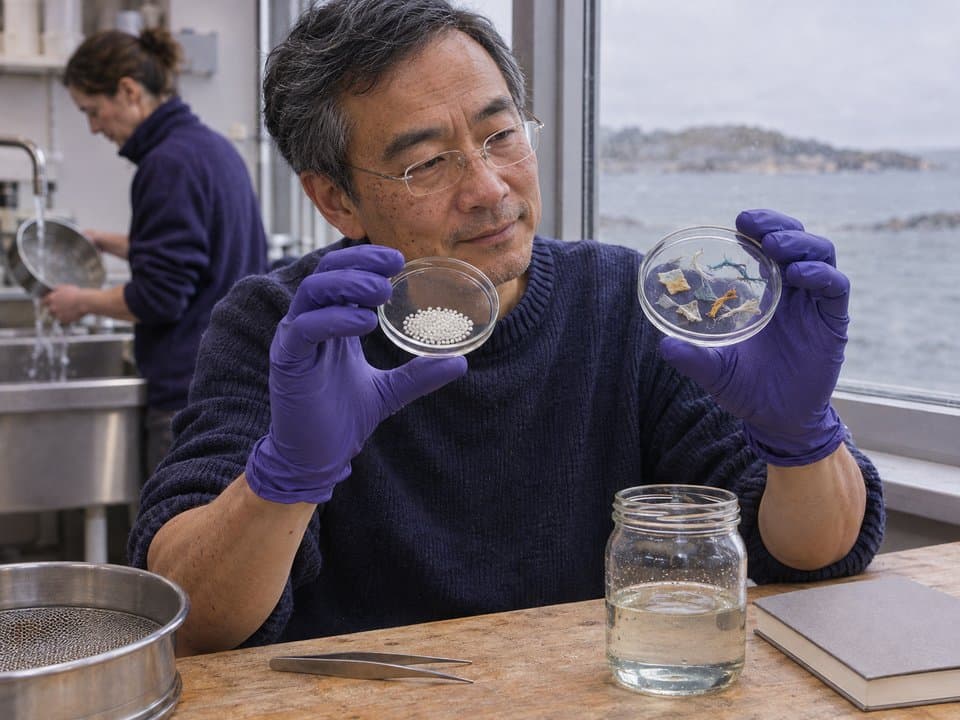
Ageing research looks partly at how cells maintain themselves and what happens when that maintenance falters. In experiments with cells and animals, plastic particles can damage mitochondria—the structures that supply cells with energy—and trigger inflammation. Some experiments also find more senescent cells: cells that have stopped dividing and can release inflammatory signals. These are processes researchers already study in ageing [5].
This gives scientists a reason to investigate. The next question is whether the experimental conditions resemble the exposure outside the laboratory. A dish of cells given uniform plastic beads is a simpler situation than a person encountering a mixture of worn fragments and fibres [2].
The amount matters too. A review of laboratory studies found that experimental concentrations were often far above those measured in the environment. The studies also often used simplified particles and short exposures, which leave important differences from real-world conditions. Those experiments help identify possible effects; they cannot by themselves tell us how much plastic exposure changes human ageing [6].
To investigate ageing in people, researchers need something they can measure. One approach combines clinical measurements into a calculated biological-age score. For example, clinical PhenoAge combines measurements such as blood sugar, inflammation markers and blood-cell counts with calendar age. Its result is expressed in years, but it is a model's estimate. It does not directly measure how fast every part of the body is ageing [7].
One US health survey brought together urine measurements and clinical measurements from the same adults. It let researchers ask whether people with higher phthalate measurements also had older calculated scores [8]. Higher levels of several phthalates were linked to slightly older scores. The study compared different people. It did not show that phthalates made them age faster.
The urine measurement also needs context. Phthalates are broken down and eliminated quickly, so a single sample mainly reflects recent exposure. Levels can vary substantially in the same person from one sample to another. A result taken today is therefore an imperfect description of their exposure over months or years [4].
Particle studies ask a different question. In one Italian study, patients having surgery on a narrowed neck artery had their removed plaque tested for plastics. Those whose plaque tested positive were more likely to experience a heart attack, stroke or death during follow-up. It was an observational study, so it cannot show that plastic caused those events. Nor does this selected surgical population establish what plastic does to the ageing of people generally [9].
Measuring particles in tissue is itself difficult: one widely used method can mistake natural fats for polyethylene. That complicates the interpretation of reported amounts. Finding material in the body, measuring an age score and tracking later disease are connected research questions, but they are different observations [10].
What about DNA-based ageing clocks?
Epigenetic clocks read chemical marks on DNA. A large survey analysis found only suggestive links between some phthalate measurements and these clocks [11]. Our literature search on 4 November 2026 found no study relating microplastic or nanoplastic particle exposure to an epigenetic-clock result. A few animal studies measured telomeres, the protective ends of chromosomes, instead, with mixed results. One at an environmentally realistic concentration found no telomere change [12, 13].
Here the research offers a particularly tangible example. In a small study, five families first ate their usual food. They then received fresh food prepared with minimal packaging contact for three days, before returning to their usual diet. Researchers measured BPA in urine across the three phases [3].
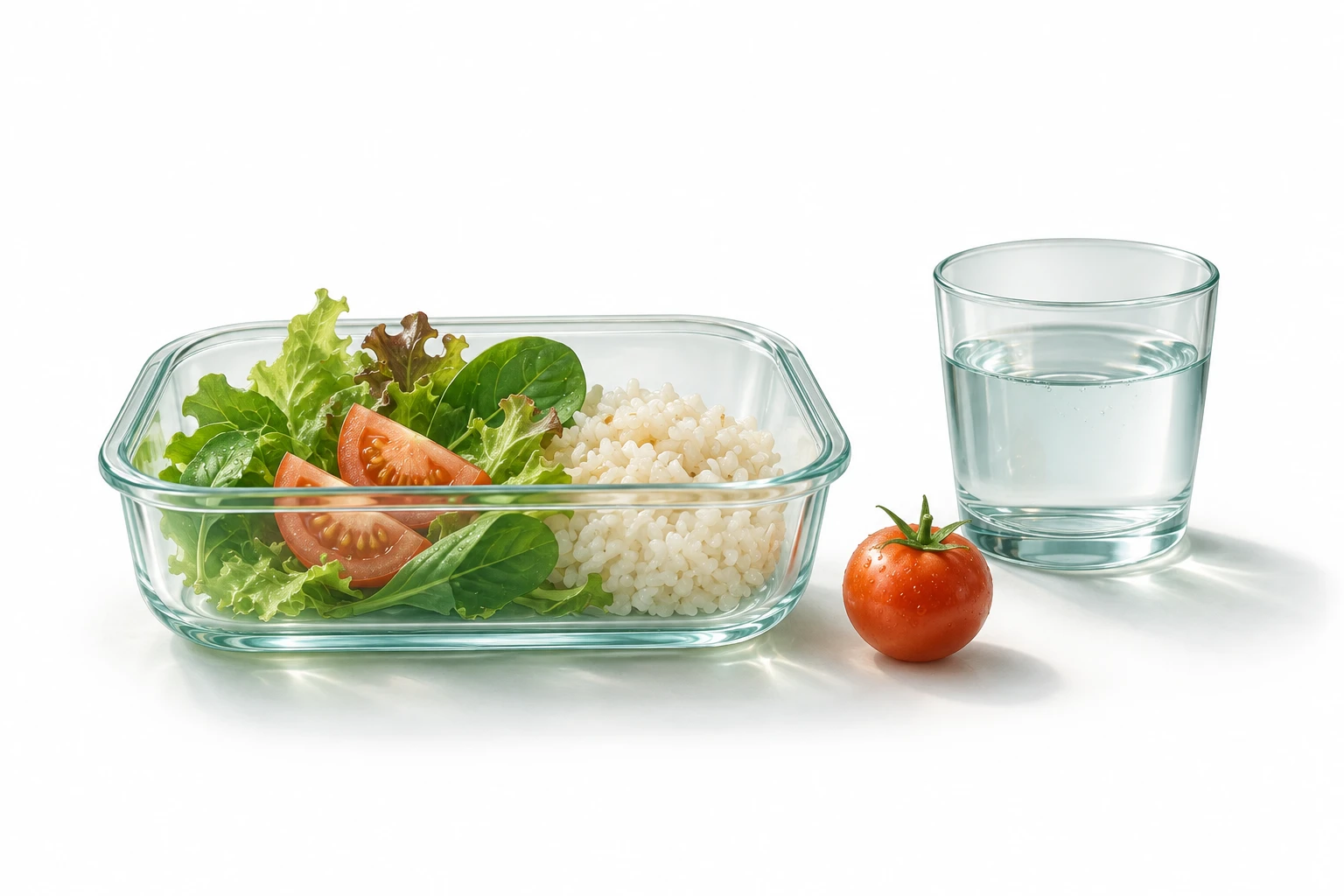
The phase averages make the change visible: lower during the intervention, then back near the starting level [3]. The bars show phase summaries, not daily readings or each person's path. This study measured exposure, not biological ageing.
A newer randomised trial also found reductions in some urinary chemicals after changes to food and other sources of exposure. But breakdown products of DEHP, a type of phthalate, did not fall. The lesson is specific. Some exposure markers respond to an intervention; the response depends on the chemical and what was changed [1].
The photograph and pictorial illustrations are AI-generated, not research images or photographs of any named company's laboratory, products or staff.- Harray AJ et al. Low-plastic diet and urinary levels of plastic-associated phthalates and bisphenols: the randomized controlled PERTH Trial. Nature Medicine, 2026.
- Wright S et al. Micro- and nanoplastics concepts for particle and fibre toxicologists. Particle and Fibre Toxicology, 2024.
- Rudel RA et al. Food packaging and bisphenol A and bis(2-ethylhexyl) phthalate exposure: findings from a dietary intervention. Environmental Health Perspectives, 2011.
- Preau JL et al. Variability over 1 week in the urinary concentrations of metabolites of diethyl phthalate and di(2-ethylhexyl) phthalate among eight adults: an observational study. Environmental Health Perspectives, 2010.
- Moulton C, Baroni A, Tasciotti E. Micro- and nanoplastics exposure across the lifespan: One Health implications for aging and longevity. Journal of Xenobiotics, 2026.
- Zhang Y et al. Gaps between laboratory experiments and real-world exposure: toxicological assessment of microplastics is based on inadequate evidence. Environment & Health, 2026.
- Levine ME et al. An epigenetic biomarker of aging for lifespan and healthspan. Aging, 2018.
- Xiao Z et al. Single- and combined-phthalate exposures are associated with biological ageing among adults. Ecotoxicology and Environmental Safety, 2023.
- Marfella R et al. Microplastics and nanoplastics in atheromas and cardiovascular events. New England Journal of Medicine, 2024.
- Rauert C et al. Assessing the efficacy of pyrolysis-gas chromatography-mass spectrometry for nanoplastic and microplastic analysis in human blood. Environmental Science & Technology, 2025.
- Khodasevich D et al. Exposome-wide association study of environmental chemical exposures and epigenetic aging in the National Health and Nutrition Examination Survey. Aging, 2025.
- Martin C et al. Growth but not corticosterone, oxidative stress, or telomere length is negatively affected by microplastic exposure in a filter-feeding amphibian. Journal of Experimental Zoology A, 2025.
- Iannuzzi A et al. Telomere length as a genomic biomarker for assessing microplastic-induced damage in farmed gilthead sea bream. Scientific Reports, 2025.