On this page (5)Hide
When researchers asked people to guess the ages of older Danish twins from photographs, their answers captured something that mattered years later. People who looked older were more likely to die during follow-up, even after their actual ages were taken into account [1].
What were those observers seeing?
They had no blood results, medical histories or scans. They were looking at faces. Yet something in those faces was connected to what was happening elsewhere in the body.
That connection is becoming one of the most intriguing questions in aging research: how much of our changing health becomes visible on the outside?
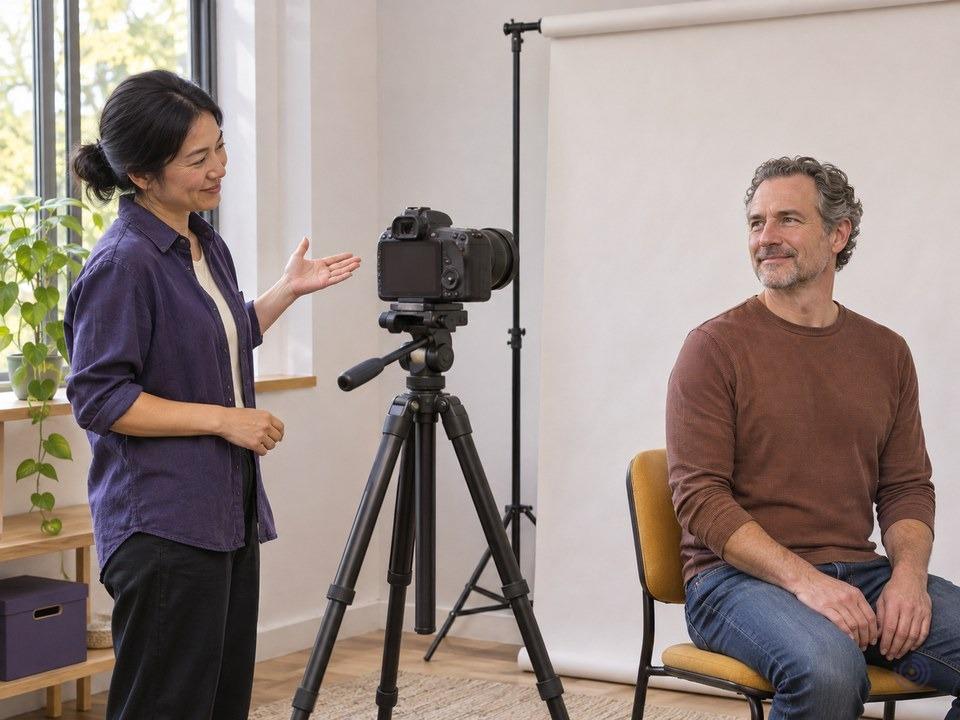
The Danish research followed 1,826 twins aged 70 and older for seven years. Nurses, young men and older women assessed photographs; the connection between older appearance and poorer survival appeared across all three groups. Recognizing the signal did not require medical training [1].
The twin study raised a question: did older appearance also accompany faster changes inside the body?
The Dunedin Study in New Zealand offered an unusually revealing opportunity. Its participants had been followed since birth and were all approximately the same age. Between ages 26 and 45, researchers repeatedly measured 19 indicators spanning several body systems, including blood pressure, lung function, kidney function and dental health. They combined those changes to estimate how quickly each person's body was aging [2].
At 45, participants whose bodies had declined faster also tended to look older to independent observers judging facial photographs [2].
This was a particularly useful comparison. An older-looking person could not simply be someone with more birthdays. And the researchers had measured bodily aging separately, without using faces to calculate it. They had not tracked facial changes over those years: the face was assessed at 45. This distinction matters when asking whether a photograph can tell us how fast someone is aging [2].
What might observers be picking up? A face changes in depth as well as on its surface. Soft tissues shift, facial fat changes, and the underlying skeleton remodels. Sun exposure and body weight also influence the result [3].
To study that geometry, Jing-Dong Jackie Han and colleagues used three-dimensional scans of 332 Chinese adults. Instead of asking how old each person looked, they measured thousands of points across the face.
Their maps captured changes around the eyes, nose and mouth, including differences in eye-corner slope and the distance between the nose and mouth. Facial measurements also showed associations with blood indicators of health. Some people whose facial geometry appeared older or younger than expected had corresponding differences in their blood profiles [3].
The study compared people of different ages, however, rather than following each face through those changes [3].
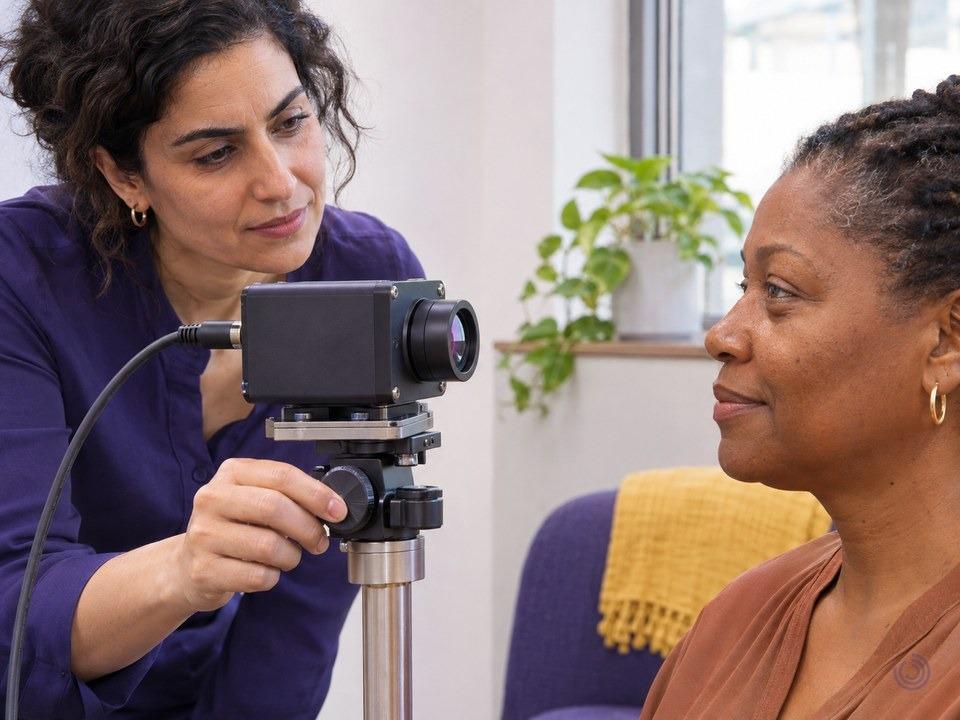
With an infrared camera, researchers can map temperature across the face. Han's group used this approach in the ThermoFace study, which included more than 2,800 Han Chinese adults. Models developed from the thermal images distinguished people with conditions such as fatty liver. The difference between thermal-age estimates and calendar age was also associated with metabolic measurements and patterns of gene activity in blood [4].
Thermal imaging requires dedicated equipment; those measurements are not contained in an ordinary selfie. Its contribution is to show that the face has more to tell us than our eyes alone can read [4].
Doctors already consider appearance when assessing a patient. Two people of the same age can differ greatly in how well they are functioning and how much treatment they might tolerate.
Facial research raises a practical possibility: could some of the information behind that visual impression be measured consistently?
The original FaceAge system approached this by learning to estimate age from photographs. During training, it was given faces with known calendar ages. It learned image patterns associated with being older or younger. Researchers then asked a separate question: did its estimates contain information about patients' survival [5]?
Across three cancer cohorts containing 6,196 patients, higher FaceAge estimates were associated with shorter survival after adjustment for clinical factors. In a smaller exercise involving patients receiving palliative treatment, adding a FaceAge-based risk model improved clinicians' predictions beyond photographs and clinical information alone [5].
This remains research into supporting clinical decisions. The study did not demonstrate that using FaceAge to choose treatment improved patients' lives, and the developers disclosed a related patent application and commercial interests [5].
A single photograph captures how someone looks at one moment. Photographs taken over time let researchers ask whether a changing appearance carries additional information.
A subsequent study examined pairs of photographs from 2,276 cancer patients who had received separate courses of radiation treatment. Using a newer facial-age model, the researchers calculated how much each estimate changed relative to the time between photographs. Faster increases were associated with poorer survival, adding information beyond the starting facial-age measurement [6].
Following the same person introduces an important new dimension. Someone may have looked older than their peers for many years; someone else may have changed markedly during illness. Those are different histories, even if their latest photographs produce similar age estimates.
These are explanatory numbers, not patient results or a calibrated measure of biological ageing. Comparing two estimates tells us their change over that interval. It does not show when the change happened between photographs, or what caused it [6].
In this study, the changes could reflect a mixture of disease progression, treatment effects and other influences on appearance. The researchers could not fully separate those contributions. Short intervals between photographs also magnified small measurement fluctuations when converted into a yearly rate [6].
The finding is nevertheless meaningful: changes in facial appearance carried information about the course of serious illness. What remains unresolved is how that relationship behaves during ordinary aging in healthier people [6].
The studies examined different parts of the puzzle: bodily change, facial structure, temperature and information learned from photographs.
They also explain why appearance and health will never match perfectly. A face combines inherited characteristics, environmental exposure and changes in several tissues. The Danish twin research itself suggested that some genetic influences may contribute to both appearance and survival [1].
When you encounter a facial-age result, ask what it represents. Is it a judgment of appearance, an estimate learned from calendar ages, or a change between photographs? A consumer tool needs evidence connecting its own measurements with the question it claims to answer. Photo quality, lighting and facial expression can affect a facial-age estimate. Consistent capture conditions help comparisons.
- Christensen K, et al. Perceived age as clinically useful biomarker of ageing: cohort study. BMJ, 2009.
- Elliott ML, et al. Disparities in the pace of biological aging among midlife adults of the same chronological age. Nature Aging, 2021.
- Chen W, et al. Three-dimensional human facial morphologies as robust aging markers. Cell Research, 2015.
- Yu Z, et al. Thermal facial image analyses reveal quantitative hallmarks of aging and metabolic diseases. Cell Metabolism, 2024. Abstract checked.
- Bontempi D, et al. FaceAge, a deep learning system to estimate biological age from face photographs to improve prognostication. The Lancet Digital Health, 2025.
- Haugg F, Lee G, et al. Face aging rate quantifies change in biological age to predict cancer outcomes. Nature Communications, 2026.
Further reading
- Xia X, et al. Three-dimensional facial-image analysis to predict heterogeneity of the human ageing rate and the impact of lifestyle. Nature Metabolism, 2020.
- Turner C, et al. Deep learning predicted perceived age is a reliable approach for analysis of facial ageing: a proof of principle study. JEADV, 2024.
- Flament F, et al. AI-Based Grading of Facial Aging Signs and Prediction of Visible Age. JMIR Dermatology, 2026.
- Bárdos-Deák B, Király B, Kerepesi C. Improving Face Age Prediction by Using Multiple-Angle Photos. Computational and Structural Biotechnology Journal, 2026.
- Király B, Fejes I, Kerepesi C. Face photo-based age acceleration predicts all-cause mortality and differs among occupations. bioRxiv preprint, 2025; not peer reviewed.
- Haugg F, Lee G, et al. Foundation artificial intelligence models for health recognition by use of face photographs (FAHR-Face). The Lancet Digital Health.
- NOVOS. FaceAge product page. Company description of its separate consumer tool.