This is the first edition of a recurring outlook on the biological age testing market. Each edition looks for new tests, new owners and new rules, and sorts what it finds by scientific method rather than by company.
The starting point is our own catalogue: 14 tests across five kinds of clock, available in 14 countries including the United Arab Emirates, where we list GlycanAge. Anything below is new relative to that catalogue. Being listed here is not an endorsement, and it does not mean we have added the test to Compare. Where the only evidence is the company’s own, we say so.
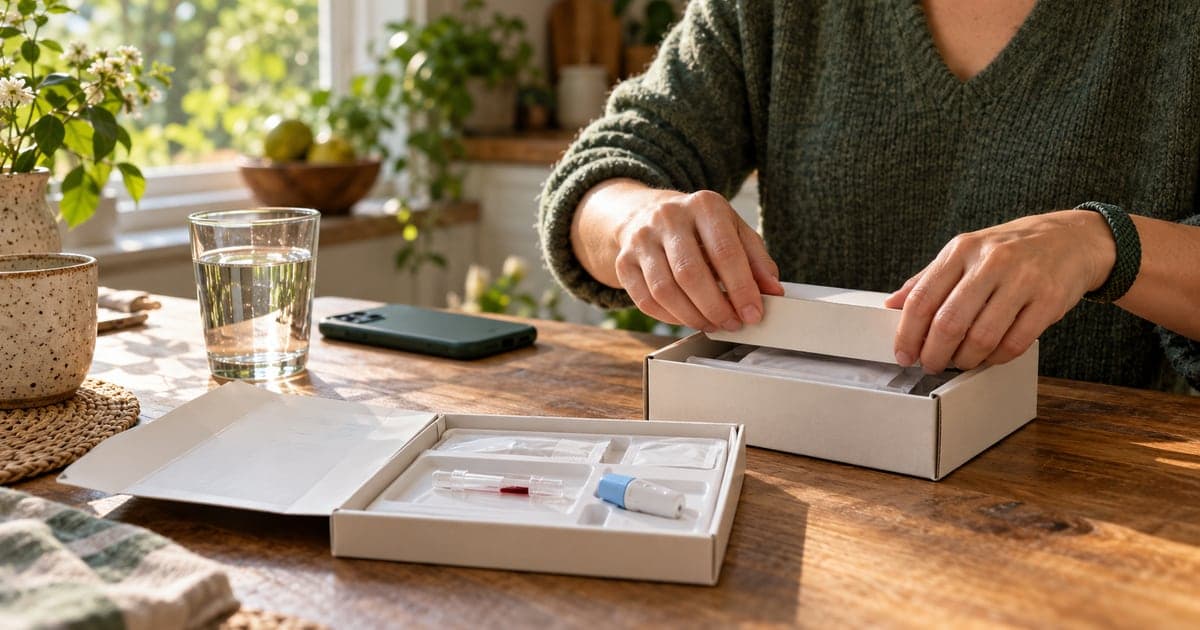
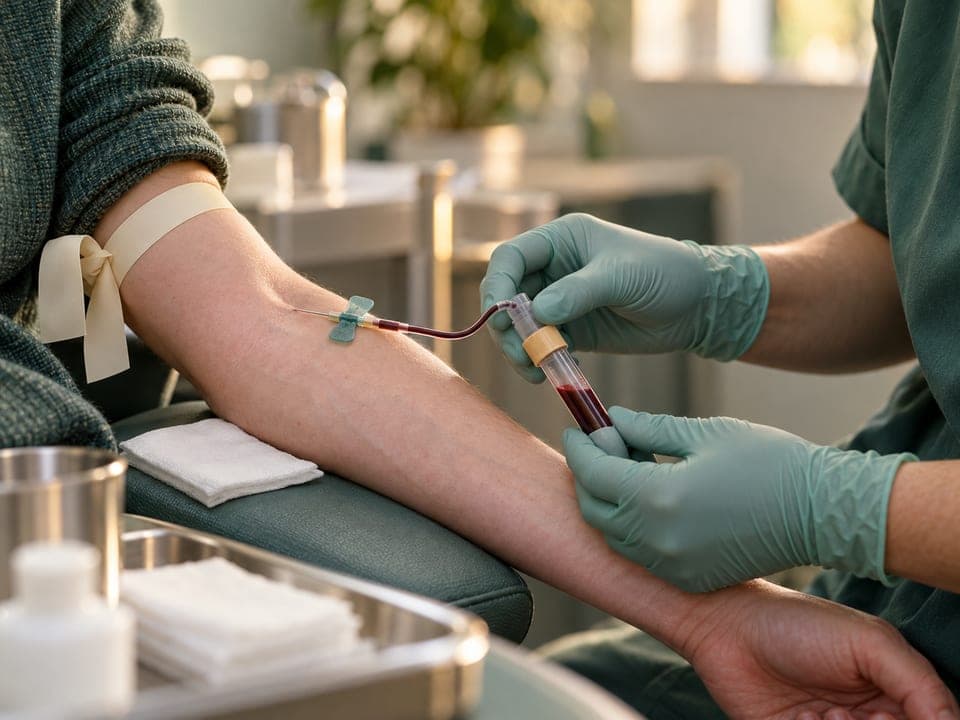
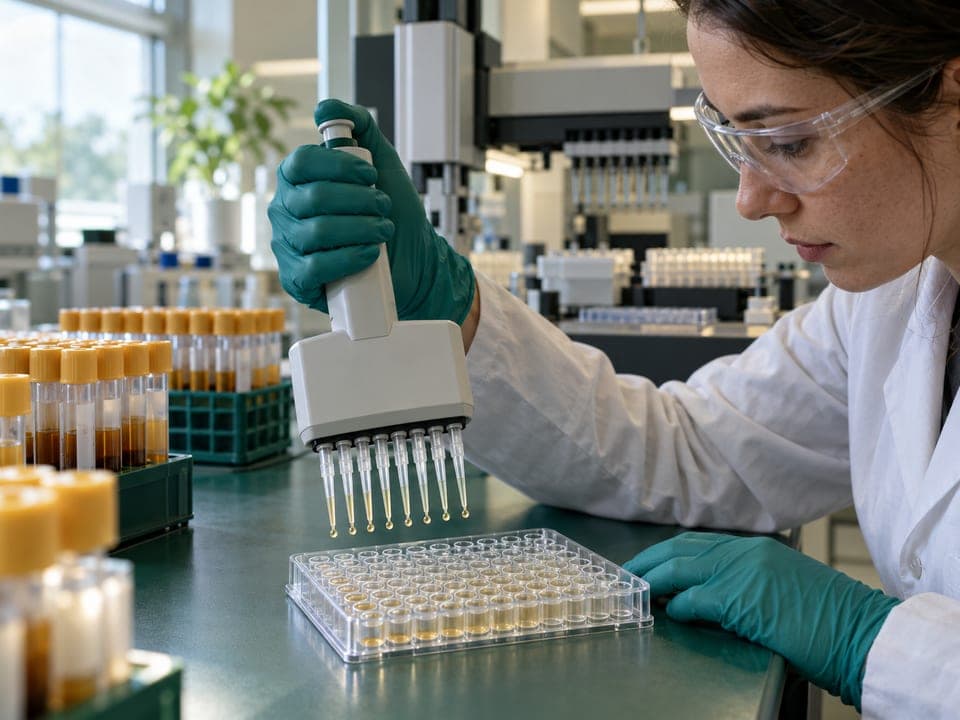
The pictures show what each test uses: a blood sample (at a clinic or lab, or with a small device at home), wearable data or a urine sample. Product names jump to our notes; the ↗ links open the company’s own page (for Abu Dhabi, the government announcement).
New products and announcements, October 2026, with status and evidence
Several tests now report a separate age for each organ or body system rather than one number for the whole body. Two new ones do it from blood without DNA methylation, and they are at very different stages.
Superpower’s organ ages come from routine blood tests, such as cholesterol and liver enzymes, taken in an ordinary blood draw.
Superpower OrganAge launched in the US on 20 May 2026. From one blood draw it reports nine scores for body systems. The launch page calls them heart, brain, liver, kidneys, lungs, immune system, metabolism, musculoskeletal system and nervous system. The product page labels them circulatory, metabolic, digestive, genitourinary, infectious, respiratory, musculoskeletal, cognitive and nervous, and the underlying model defines each one by a group of causes of death, such as genitourinary or infectious disease. It uses routine blood tests, such as cholesterol, liver enzymes, kidney markers and blood cell counts, rather than a protein panel. At the time of checking it was listed at $99 plus a $199 membership. Superpower offers it through Quest in 39 US states and Washington, D.C., and through a separate laboratory version in New York and New Jersey.
Superpower says it is based on a model, developed with Buck Institute scientist David Furman, that was trained on about 456,000 UK Biobank participants against records of who later died and from what cause. That model has so far been published only as a preprint, which means it has not been through peer review; we found no journal version as of 22 October 2026.
Protein clocks measure thousands of proteins in plasma, the liquid part of blood, in a specialised lab.
Vero has stronger published science behind it, peer-reviewed rather than a preprint, but its product is at an earlier stage. Its protein-based organ ages build on research from Stanford’s Wyss-Coray group, published in Nature Medicine in 2025 using about 45,000 UK Biobank participants. Tony Wyss-Coray is a co-founder of Vero. By Vero’s own description, the commercial test reads a different, larger set of proteins than the published model. In August 2026 Vero announced an exclusive consumer licence to a related Stanford “cell clock”, described in Nature Medicine in June 2026, that estimates the ages of more than 40 cell types from blood proteins.
These studies describe groups of people. A study that links organ ages to health outcomes across tens of thousands of participants does not show how reliable one person’s score is, or what to do about it. In the Stanford group’s own repeat measurements in about 1,200 people, taken about nine years apart, 68% of those first flagged as extreme agers in an organ were no longer flagged, although about three in four still leaned the same way. Over nine years, real change and measurement noise cannot be told apart. See the limitations of aging clocks.
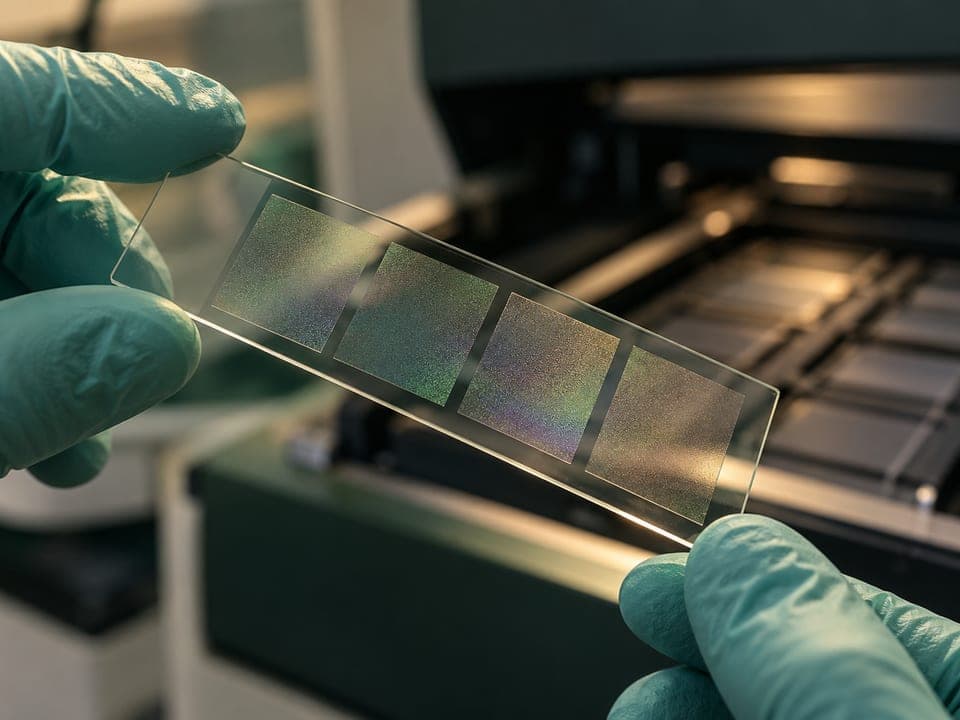
Epigenetic tests read DNA methylation, chemical tags on DNA, often with a microarray slide like this one.
Generation Lab SystemAge 2.1, released in June 2026, reads DNA methylation in blood. Instead of a standard clock formula, it measures how much methylation varies at a set of sites whose average level stays stable with age. The company calls this variability “biological noise”. The company says it reports on 21 organ systems, and that version 2.1 adds coverage of skin and connective tissue, the reproductive system and mitochondrial function, with separate versions for men and women.
All of the performance figures we found come from the company. Its launch release claims “99% accuracy” across 1,605 test cases without saying what was measured, and its own website gives different figures (99.9%, and 99.4% to 99.5% agreement between repeat runs of one sample). The release also says the method, published in the journal Aging, outperforms DunedinPACE and PhenoAge in accuracy, sensitivity and specificity. The release names no specific paper. The company’s website cites a 2023 paper by its co-founder’s lab, which criticises PhenoAge and other clocks but reports no head-to-head test of accuracy, sensitivity or specificity against either clock, and did not test the product as sold. We found no peer-reviewed or independent validation of version 2.1, so the performance figures are marketing claims for now.
WHOOP Age is built from about six months of sleep, activity and fitness data, mostly from the band; no sample is taken.
WHOOP Healthspan gives a “WHOOP Age” and a weekly “Pace of Aging” score. It uses no blood or DNA. It combines about six months of sleep, activity and fitness data, such as sleep consistency, steps, heart-rate zones, estimated VO2 max and resting heart rate, using published links between each factor and the risk of dying from any cause. WHOOP labels it for wellness purposes only, and it needs a WHOOP Peak or Life membership. WHOOP’s own white paper reports that WHOOP Age was higher on average in members who rated their health as poor or had chronic conditions, but it has not been tested against later health outcomes. We found no independent validation, and we could not confirm in which countries it is offered. For the wider picture on non-molecular measures, see digital biomarkers of ageing.
United Arab Emirates: what is offered and what the rules say#
Apart from GlycanAge, which we already list, Thrive by myAster is the one new consumer product we could confirm from the company’s own page. Some clinics in Dubai and Abu Dhabi also offer biological age tests, for example TruAge, which we list, and a DNA methylation test inside King’s College Hospital Dubai’s longevity packages. Trade news also reported an Ultrahuman blood test with a “Blood Age” score launching in the UAE in October 2025, which we could not confirm is offered today. Policy developments matter more than any single product.
1 · MandatoryMedical history, physical exam and routine blood and urine tests, such as CRP for inflammation
2 · Optional, recommended if resources allowFitness and heart tests, bone density, FDA-approved sleep wearables, stool-based gut microbiome testing
3 · Optional, needs further validationDNA methylation, glycan testing, immune-cell profiling, advanced protein or metabolite panelsIncludes the methods behind at least 11 of the 14 tests we list
4 · Not recommended outside researchTelomere length, non-FDA-approved or unvalidated wearables, senescence markers
How Abu Dhabi’s Healthy Longevity Medicine Clinic Standard sorts testing methods for licensed longevity clinics, from required to research-only. It classes methods, not products.
Abu Dhabi: methods classed as “needs further validation”
The Department of Health’s Healthy Longevity Medicine Clinic Standard (version 1, in force since April 2025) lists DNA methylation, immune-cell profiling, glycan testing and advanced protein or metabolite panels as “optional and needs further validation”. That tier covers the methods behind at least 11 of the 14 tests we list: the ten epigenetic tests and GlycanAge. iAge, which measures five inflammation proteins, is harder to place: it could count as an advanced protein panel, but standard inflammation markers such as CRP are in the standard’s mandatory tier. Telomere tests and non-FDA-approved or unvalidated wearables are “not recommended outside of research protocol”. Stool-based gut microbiome testing sits one tier higher, as optional and recommended if resources allow; oral and other microbiome tests are in the “needs further validation” tier. The standard sets rules for clinics licensed to provide longevity medicine in Abu Dhabi. It does not address kits sold directly to consumers, and it classes methods rather than approving products.
Dubai: a permit for longevity activity, rules still to come
Dubai Law No. (17) of 2026, issued on 6 June 2026, created the Dubai Longevity Authority. It defines longevity to include methods for measuring and detecting biological markers of ageing, and it requires a permit for longevity activities, including selling longevity products and providing preventive or medical services, free zones included. Biological age testing is not named, so we read it as covered by that wording. This is our reading of the text, not legal advice. The authority’s strategy was approved in late September 2026, but we found no published permit procedures as of 22 October 2026. The law covers Dubai only.
Announced: a state-backed model for Abu Dhabi
On 12 October 2026 the Abu Dhabi Public Health Centre and Ultrahuman Healthcare announced a two-year memorandum of understanding to develop and clinically validate a “Biological Health Age” model for Abu Dhabi. It would combine clinical test results with wearable data on heart health, sleep, metabolism and recovery. It is planned, not built: there is no rollout date and no published validation.
United States: federal plans on aging, October 2026#
Infinite Epigenetics, the parent company of TruDiagnostic, bought Tally Health in an asset purchase announced on 29 April 2026. The release gives no financial terms. Tally Health continues as a separate consumer brand with TallyAge as its main product, so we keep TruAge and TallyAge as separate listings and note that they now share an owner. Plans in a press release can change.
Studies like these draw on stored samples from many people. Their findings describe groups, not how far one person’s result can be trusted.
A few peer-reviewed studies from the past year matter for anyone choosing or reading a test. None of them checked how well a specific commercial test performs as sold, although two looked at clock formulas that some tests report.
Age from a face photo. In October 2026, researchers at Mass General Brigham and Maastricht University described in The Lancet Digital Health an AI model that estimates age from an ordinary face photo. In about 38,000 people having radiotherapy, mostly for cancer, looking older than one’s age was linked to shorter survival, and the link held in about 4,900 patients in the Netherlands. The model was trained to guess calendar age, and on public photo collections its guesses were on average about five years off. Its link to survival has been tested only in patients, not in healthy people.
Organ ages from an independent team. A team at Oxford and Harvard, declaring no competing interests, built its own protein-based organ clocks in UK Biobank and found similar links to later disease and death in cohorts from China and the US.
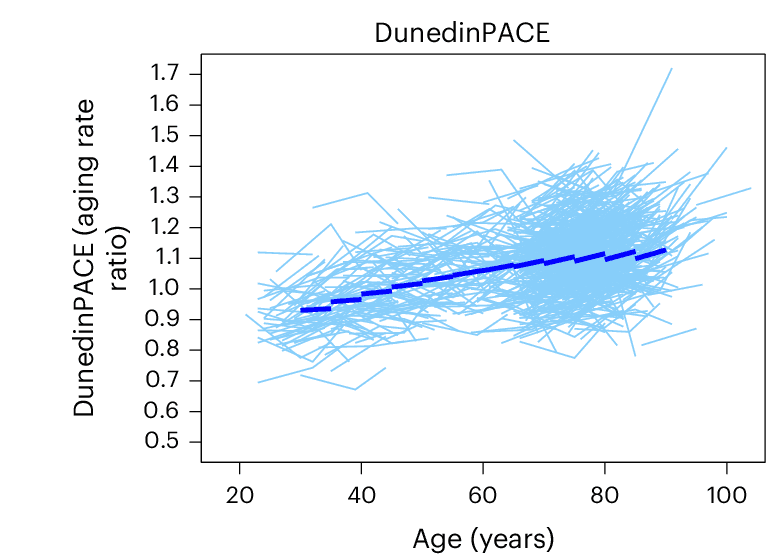
Each light line is one person in the Italian study, tested two or three times over up to 15 years; the dark line is the average trend. Cropped from Kuo and colleagues, Nature Aging 2026, Fig. 1, CC BY 4.0.Change over time. In 699 adults in Italy whose blood was tested two or three times over up to 15 years, faster rises in several epigenetic clocks were linked to shorter survival once the first result was taken into account. On its own, the change was linked to survival for only two of seven clocks.
Response to treatment.A Yale-led analysis of 51 studies found that clocks built on mortality or pace of aging moved most consistently after a treatment or lifestyle change. Several authors work for or consult for TruDiagnostic, whose test we list, and the authors say it is still unclear whether such changes mean better long-term health.
All four report results for groups of people. None shows how far one person’s biological age result can be trusted.
A few questions sort most launch announcements into useful and not yet useful.
Who produced the accuracy figure? A company’s own test on its own data is a starting point, not independent evidence.
Is it peer-reviewed, a preprint, or neither? Preprints are shared before experts have checked them.
Does the research apply to the product? A published model is not the same as the commercial test, which may use different markers or settings.
Is it reliable for one person?A 2026 peer-reviewed analysis of six well-known epigenetic clocks, and more reliable versions of them, found that a change reported by only one clock was often not confirmed by the others. Clocks built on mortality or pace of aging picked up known age-accelerating events, such as surgery or chemotherapy, more consistently than clocks trained on calendar age. The study looked at groups of people in research datasets. It does not show that any consumer test is reliable for an individual.
This edition is incomplete, and it is better to say so.
Whether other 2025 and 2026 launches exist that we did not verify, including products from Function Health, Mito Health, Hurdle, Humanity and Cambridge Epigenetix, protein-based tests such as Teal Omics, telomere tests and retinal or imaging-based ages. Not confirmed does not mean they do not exist.
The full picture of which international tests UAE clinics offer and at what price. We found some examples, such as TruAge at DNA Health clinics in Dubai and Abu Dhabi, but no complete list. We also do not know whether these clinics will need a Dubai Longevity Authority permit once its rules are issued.
Whether Superpower’s model has been published in a peer-reviewed journal, and whether either Superpower’s model or Generation Lab’s product has been compared independently with established clocks such as GrimAge or DunedinPACE. Generation Lab’s underlying method was published in 2023 by its co-founder’s lab, but that paper did not test the product as sold.
Details we tried to check and could not: Generation Lab says SystemAge is used by more than 750 clinics in 18 countries (its press release), but its own website also says 300+ clinics, and we could not verify either figure. Vero’s FAQ says its test reads more than 11,000 proteins and reports 10 or more organs, while the published UK Biobank model used about 2,900 proteins and a clinic offering a Vero test lists 7,000 or more, so we could not confirm what the product measures.
New does not mean better. For most people the practical advice is unchanged: choose a test built to answer the question you are asking, expect the number to move for reasons unrelated to your health, and treat a single result as a conversation starter, not a verdict.
If you are in the UAE, ask any clinic offering a clock which method it uses, how the result is calculated and whether the clinic holds the relevant licence or permit. If you read a launch announcement, check the evidence before the headline. To see how the established tests compare, use Compare, and to understand a result you already have, read what your test results mean.
Fuentealba, Furman and colleagues, DiseaseAge model, bioRxiv 2024 Preprint, not peer-reviewed. Senior author David Furman co-wrote Superpower’s launch page, which says the test was developed in partnership with him; the preprint declares no competing interests.
Ding and colleagues, proteomic cell clock, Nature Medicine, June 2026 Peer-reviewed. Senior author Tony Wyss-Coray co-founded Vero; he, two co-authors and Stanford filed a patent application on this work, and Vero announced an exclusive consumer licence in August 2026. The paper’s competing-interest statement does not mention Vero.
Human Longevity: Vero Proteomix Clinic product page, checked 22 October 2026. It does not name Vero Bioscience, so the link to Vero is likely but not confirmed by this page.
Generation Lab: our science page Science page of the test maker, checked 22 October 2026; source of the repeat-run figures, the 300+ clinics figure and the citation of the 2023 Aging paper.
Generation Lab: SystemAge test review Blog of the test maker, checked 22 October 2026; source of the needle-free collection device worn on the upper arm.
Generation Lab: authorized partners Product page of the test maker, checked 22 October 2026; lists where the company says it has partners, not where sales are confirmed.
Aster DM Healthcare: Thrive by myAster Product page of the test maker, checked 22 October 2026. Prices and discounts differ between Aster pages and change often.
This article was prepared with AI assistance from claim ledgers that separate AI analysts compiled from the sources, and its text was reviewed against the cited sources by another separate AI session. The pictures are AI-generated images of typical scenes, not photographs of the named companies’ products or staff; the line chart is cropped from an open-access paper (CC BY 4.0). No external expert validation. Sources checked 22 October 2026. See our methodology or report a correction.